


 |
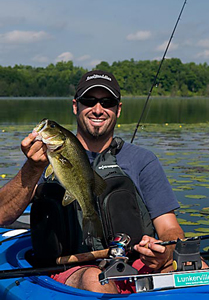
| Don Theoret fished a weedy bay to land this largemouth bass take on a topwater frog. |
Kayak fishing is one of the hottest trends in the outdoor industry today. Extremely popular with coastal anglers, the paddling-and-angling approach is quickly drifting inland as freshwater anglers catch the kayak-fishing bug.
More freshwater enthusiasts are becoming kayak converts — and for good reason. Compared to power boats, kayaks are a low-cost solution for getting off the shore and on top of some great fishing spots. Although there's no shortage of fish you can target out of a kayak, paddling your way to a largemouth backwater bonanza is one of the most effective — and enjoyable — ways to spend a day.
Bass fishing and kayaks are a natural fit. Big bass make no distinction between massive reservoirs and small farm ponds, and many of the largest bass on record have come from relatively small bodies of water. A kayak gives anglers access to these lightly pressured fisheries that are often unreachable by larger boats.
Beyond the Limits of Powered Bass Boats
A major advantage to kayaks is their ability to access ponds, rivers, and backwater areas that are normally off limits to bass boats. These areas frequently hold quality largemouth that see far less fishing pressure. Before launching, look for smaller backwaters connected to larger systems known to hold bass — if fish are present in the main lake, they’re often present in these quieter areas too.
For exploration and accessibility, many anglers prefer a sit-on-top kayak. This design allows anglers to easily get in and out of the boat and fish comfortably in shallow water.
Why Kayaks Excel for Bass Fishing
Kayaks are lightweight, portable, and easy to transport with a roof rack or cart. There’s no trailer, motor, or fuel to maintain, making them cost-effective and environmentally friendly. Kayaks also allow anglers to quietly navigate water less than a foot deep, slip into spawning flats, and reach tight cover without spooking fish — an advantage that power boats simply can’t match.
Slop Fishing Stealth
One of the most exciting ways to target largemouth bass from a kayak is with topwater frogs. Kayaks let anglers slip right into the heart of heavy vegetation where big bass live. While paddling through thick cover can be challenging, the stealth advantage is worth the effort.
When fishing topwater frogs, expect strikes at any point in the retrieve — including right beside the kayak. This close-quarters action happens far more often in a kayak than in a power boat.
For frogging, a heavy-power baitcasting setup with a high-speed reel helps pull fish out of thick cover quickly. In some situations, dropping an anchor along the edge of vegetation can help prevent being pulled into the slop during a fight.
Slam ’em on Spinnerbaits
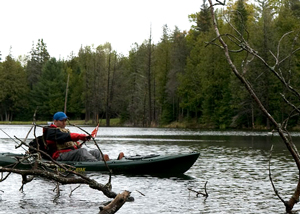 |
| Jamie Pistilli paddles an Ocean Kayak through shallow water to a back bay off limits to larger power boats. |
A spinnerbait is one of the most versatile search lures for kayak anglers. Its horizontal presentation works well from a seated position, and the single hook design reduces the risk of tangles and boat-side mishaps.
Spinnerbaits allow anglers to efficiently cover water along shorelines and weed edges. Bulge them near the surface or slow-roll them over submerged vegetation to quickly locate active bass.
Finesse ’em With Softbaits
Softbaits are extremely effective from kayaks. Drifting and hopping grubs, tube jigs, or Texas-rigged worms is a deadly way to intercept fish. When conditions are calm, wacky-rigged soft jerkbaits can be especially effective.
Dunk Weed Pockets
When bass bury deep in weeds, short-line flipping and pitching jigs into weed pockets can produce bites. Keep lures positioned in front of the kayak to maintain balance and ensure solid hooksets.
Many modern fishing kayaks are stable enough for standing presentations, allowing anglers to adapt vertical tactics with a little practice.
Being Low Is a Good Thing
The low seating position of a kayak excels for skipping baits under docks, trees, and overhanging cover. Side-arm casts with tubes, soft jerkbaits, or creature baits allow anglers to reach fish that rarely see lures.
Additional Kayak Bass Fishing Tips
Although you don’t need multiple rod setups, carrying two rods helps cover more situations — one with a soft plastic and one with a shallow hardbait like a Bass Pro Shops XPS Suspending Minnow. Changing presentations often triggers strikes when bass refuse one lure.
Wearing quality polarized sunglasses, such as Maui Jim Stingray sunglasses, allows anglers to spot fish and structure before making a cast.
Landing your kayak occasionally and fishing from shore lets you stretch while accessing lightly pressured water. Bring shallow-running lures, topwater baits, frogs, buzzbaits, and weightless soft plastics rather than deep-diving lures.
Bonus Tips:
- Carry a sponge for bailing water and cleaning up.
- Use paracord to tether gear in case of a tip-over.
- Wear sunscreen or protective clothing — extended exposure can lead to severe sunburn.
As you can see, many power-boat bass-fishing techniques translate well to kayaks. If you haven’t tried it yet, consider borrowing or renting a kayak and exploring waters you already know hold bass. Once you hook into a largemouth from a kayak, you may find yourself fully converted to one of the fastest-growing trends in freshwater fishing.
For more tips on kayak fishing, check out the kayak tips on Bass Pro Shops 1Source.
- 43458 views